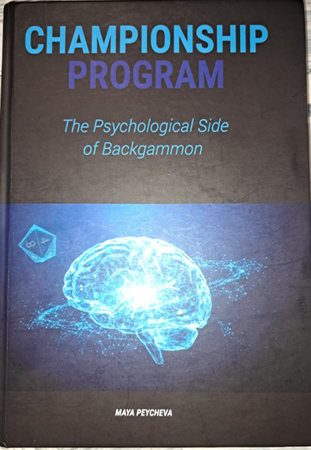
The Psychological Side of Backgammon
By Maya Peycheva
Sofia 2026
Bulgari publishing house
ISBN 978-619-7656-78-7
Introduction.
This is a book that will suit all backgammon tournament players. It will be useful for every level of player from Intermediate to Open level National and International players. It is the only book I have come across that covers the psychological aspects of backgammon with reference to modern neuro-scientific theories. The main premise is that repeatable success at backgammon is not born solely from correct moves and technical precision. It requires other key qualities – emotional stability, control under pressure and the ability to carry the game through to the very end. It is concise and easy to read and I initially read it in one session.
Content
The book is divided into three sections. Section One covers the players psychological preparation while Section Two goes from inner preparation to tournament reality. Section Three covers the physical requirements and energy required to compete.
Section One concentrates on the personal qualities needed to become a consistent tournament performer. It covers personal development in backgammon not as an addition to preparation, but as the preparation itself. Chapters cover Self-Assessment, Esteem and Confidence. The important topic of “Fear – The Invisible Opponent at the Board” is covered in detail including all different manifestations of this emotion and how it may affect your game. Emotional control is covered in the context of the different levels of progress through a tournament from the first rounds through to the grand-final. The different forms of Motivation come next including those that pull you “Towards” a goal and another form that pushes you “Away From” which is another type of fear. An up-to-date explanation of the neuroscientific aspects of motivation is discussed.
The important topic of “Burnout” is covered and how it manifests itself. I found this quite interesting as after three years of very intense study and play, following my return to the game in 2022, I felt I suffered from this phenomenon and took a rest from playing for six months.
Resilience, Patience, Concentration and Intuition complete the other chapters in Section One. The final part of this section is about “Presence and Psychological Influence” and looks at how you deport yourself at the board and what messages this gives to your opponents. This is a topic I have also spent some time exploring previously to help me develop my persona over the board.
As well as covering the whys and wherefores of each topic most chapters also contain exercises that will assist one in overcoming any of the aspects of this book that the reader may feel apply to them.
Section Two is entitled “From Inner Preparation to Tournament Reality” the subtitle of which is “Preparation creates the competitor. The tournament reveals whether they can remain that competitor.”
The section starts with a chapter on Practical Self-Development which covers many of the aspects of study required by most tournament players today. There follows a chapter covering how to improve the technical aspects of your play using analytical software and how to develop these practices into coherent long-term plans. Tactics before and during tournaments are then covered including how to deal with all the different levels and types of opponent you may encounter at an event. There is an important section that includes the common tactical mistakes one can succumb to during play. This is followed by a discussion about breaks and how to use them effectively. Strategy and Practical Tournament Thinking looks at the difference between tactics and strategy and the main types of game and match strategies and practical tournament thinking. The physical aspects are not neglected and are discussed in “Acclimatisation and Adaptation” and how to cope with these aspects during International travel to tournaments. Luck finally makes its appearance in the final chapter of Section Two and the discussion centres around the Psyche as a filter for the game. The golden rule of luck is “Luck is not what happens to you. It is what remains when you are prepared, calm and completely focused on the game“.
Section Three. Energy and Physical Maintenance. The chapters here cover how the maintenance of one’s physical fitness and energy enable a player to better survive the rigors of a backgammon tournament. Movement, Sleep, Nutrition and Breathing are discussed with strategies for best practice and maintenance of this important dimension of the game. The important roles of Meditation and physical exercise (in this instance Yoga) are covered. This is followed by a concluding chapter that asks the question in the discussion – “Whom do we call “the best” – the one who plays most correctly, or the one who knows how to win?”
Highlights
Among the highlights of her many accolades in 2022 Maya won both Super Jackpots (of 64 and 32 players) at The Cyprus Open. In 2025 she won the Anniversary Istavder Tournament (730 entrants) and a week later the Sofia Open with 150 entrants. Winning any large-field tournament shows high skill, strong mental focus, and great consistency under pressure. It proves she can beat a deep group of rivals over multiple rounds. She clearly has significant experience of tournament backgammon. Maya has a background in sport – two Bachelor’s degrees, one as a volleyball coach and one as a physical education teacher, as well as a postgraduate qualification in Sports Management. But psychology has always been of particular interest to her, which is why at tournaments she observed people very carefully – including herself. She has developed an interest in the topics covered by this book over the previous twenty-five years.
In discussions with Maya, I have found her main source of this material was her own tournament experience. After every match and every tournament, she would write down what had happened, how she had felt, how she had reacted, how her opponent had reacted, and how those reactions had affected the decisions and the result. This is a highlight for me and an extremely useful practice. It is something I will now incorporate into my backgammon education.
The topics are covered in detail including exercises to help the reader identify their own short-comings. The practical strategies and self-help exercises which are outlined will give one a comprehensive program for the development of your own psychological strength over the backgammon board. Most topics are also summarized in a “Golden Rule” for the topic each of which I have already extracted for incorporation into my tournament preparation regime. I think these practical examples, which are clearly derived from the authors own experiences, make the book a valuable addition to the library of any tournament backgammon player. Topics are covered in sufficient depth for all levels of players. I am sure the contents will have a significant practical impact on all players who read it.
Recommendations and final evaluation.
I have developed a specific interest in these aspects of tournament backgammon since my return to the game five years ago. During that time, I have developed many of the habits and strategies outlined within this book. For me that has meant a wide range of additional reading and research covering these topics. It is interesting that Maya and I have come to similar conclusions even though we approached the issues in different ways. The book has however given me some additional ideas, particularly in the sections where self-analysis is discussed. For someone who is interested in these aspects of the game, this book will save you a lot of the time to research these topics in detail. It will give you a blueprint to develop your own psychological style and profile to enable you to compete more effectively. I think this book will become a definitive guide to these aspects of the game and I’m sure future editions will expand on the topic as more research is incorporated into it. Most backgammon books are expensive these days but this must represent value for money as 25 years of tournament experience are condensed into this very readable title. For the cost of a standard backgammon lesson you will gain far more than you will imagine. I would recommend it highly to anyone who has ever, or is thinking of, entering the world of tournament backgammon.
As it was a first English print of the book there are a few typographical errors which Maya maintains will be addressed in the next edition. Only 100 copies were available for this run, of which at the time of writing only 34 remain so you’ll have to be quick to bag yourself a copy of this very readable book.
It’s not appropriate for me to give out Maya’s email address in a public forum but you can contact her on Facebook or via Facebook Messenger. Search for Maya Peycheva. Regards, Stefan.
Where can I buy a copy of this book?
Thank you Stefan for such a detailed endorsement of Maya’s book.
I look forward to picking up my own copy at some point.
There is no backgammon strategy book that can teach me anything about BG, yet there is a big gap between my game knowledge and my tournament results, to me this book sounds like the missing piece of MY puzzle.
I look forward to picking up an edited copy when the next batch is released.