Two Astonishing Participants in our Beloved Game of Life
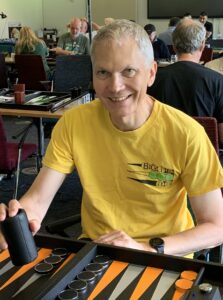
Our “pilot” episode of BG Life Stories was deemed sufficiently fluid and absorbing by UKBG Towers that the column has a future! [Many thanks to the guinea pigs, Ray, Rachel and Ian]. And who better to keep the kettle boiling than our titled PJB & YKC… Their contributions to backgammon are terrific and warm the coldest of hearts. And it’s only part accident that I’ve paired them together as they have been teammates in competition stretching back well over a decade. I recall my shock at Peter’s deadpan delivery when in a team of three with Yan at the Nordic Open in 2011, he said, “Yeah, we’re the Three Blind Dice.” It’s the sort of thing when you wonder, ‘did he just say that?’ but the affectionate, gallows humour is priceless.
Another time, Yan was on a flight with Peter and challenged him to some backgammon. “Nice idea, but alas, we have no board”, replied Peter.
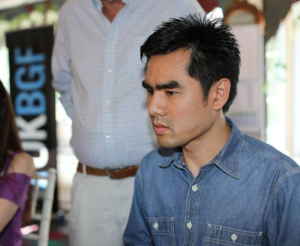
“Oh, we play in our heads,” replied Yan. To him, no ‘biggie’, but to Peter, a task just beyond the imagination.
Anyway, here are their stories, which I am delighted to have elicited. Backgammon is all the richer to lay claim to such wonderful ambassadors.
1) Describe your roots and history in the game.
PJB: Early in the summer of 1975, I was approaching the end of my final year at Uni when I first saw backgammon being played by two other students. The game looked fascinating, but I hadn’t a clue what it was all about and they were too engrossed for me to interrupt them to ask. Around the same time, I happened to catch a radio interview with a top backgammon player which made me prick up my ears. I already enjoyed various card and board games, so I mentioned my curiosity about backgammon to my sister. She had been wondering what to buy me for my 21st birthday, and this solved her problem!
That’s how I know that 22nd June 1975 was the exact date on which I learned the rules of backgammon – when I opened my new board and read the enclosed leaflet. My sister thoughtfully also gave me The Backgammon Book, by Oswald Jacoby and John Crawford. For a pre-Magriel book (it was published in 1970), this was about as good as they got! All I needed now was someone to play….

YKC: I moved to the UK to study in a boarding school for blind people when I was 15. One of the staff knew that I competed in Chess and played a lot of board games, so he decided to distract me and introduced me to Backgammon. I discovered DailyGammon soon after, which was the only site I could play on with a screen reader (software that speaks out loud what is on the computer screen for blind people).
PJB: So then I had a board, some idea of how to play, and I soon found two regular opponents: a work colleague and a Uni friend. The latter would come over on occasional Saturday afternoons and we would play for 10p per point (later inflated to 20p) until it got light on Sunday morning! I also began to enter small tournaments at various London venues during the late 70s and early 80s, including the grandly named, but rather seedy, Grand Slam Bridge Academy, the Water Rat pub, the Grosvenor Backgammon and Bridge Club, and (less frequently) the Double Fives club in Exhibition Road. In 1981 at the Grosvenor, I won a 32-player qualifier for which the prize was a week’s stay at the Dunes Hotel (since knocked down and replaced by the Bellagio) in Las Vegas, including flights and entry into round 6 of the Beginners division of the Plimpton Cup. That trip introduced me to a few well-known players of the day, plus the world of card counting in blackjack! Luckily for me I didn’t waste too much time or money on blackjack and instead stuck to backgammon.
In the mid-1980s Stocks club in Chelsea, owned by Victor Lownes of Playboy fame, began a regular Monday evening tournament which continued until about 1990, and I attended this regularly. The end of the Stocks tournament coincided with the start of my ‘rest’ from backgammon for almost a decade. During the 90s I hardly played, although I kept in touch with developments in the game through my subscription to the magazine Inside Backgammon, written and published by Bill Robertie and Kent Goulding.
YKC: In the next 10 years or so, I continued to play Chess, picked up Go for a while when I moved to London – these games are relatively easy for blind people since the pieces do not move very much, and most importantly there’s no dice involved.
One weekend, I decided to join the London open. I am forever thankful to Mike Main who let a blind person play in a Backgammon tournament for the first time in his Backgammon-director life without hesitation.
PJB: Then in 2000 I began playing regularly at BIBA and other tournaments…this was the era when the bots revolutionised backgammon or, as some think, killed some of its mystery and allure. I have played regularly since the millennium, using the neural nets – first Jellyfish, then Snowie, and now eXtremeGammon (XG) – to help improve my game. Nowadays XG is an essential learning tool – many old school players who eschewed these bots have been left behind.
This resumé wouldn’t be complete without mentioning my involvement in the founding and development of the UK Backgammon Federation. My son built the UKBGF website in 2013 and, as a Board member for the first eight years, I was Vice-Chair, Treasurer, Membership Secretary, and first responder to email queries. If you’re not aware of how the UKBGF began, but are interested, take a look at “In the Beginning…” on the About page, and also the report on the 2014 UK Open, which was attended by Mochy, Michy and Akiko. Among other things, this 2014 report describes how my good friend Yan Kit Chan (also featured here) won the 2014 UK Open Intermediate tournament.
YKC: In my opinion, the act of playing, performing, doing something, is never an obstacle for blind people; rather the act of learning is often a big barrier. For Backgammon specifically, it’s impossible for me to read any Backgammon book independently, difficult to watch the experts play. With help from many people, software apps have been developed so that I can now learn and play the game independently.

PJB: The self-appointed members of the UKBGF ‘Interim Committee’ began their discussions in the Summer of 2013 with good intentions but no money – in fact these committee members lent money to the nascent UKBGF to buy equipment, including a considerable number of boards; money which was all subsequently repaid. Most players today appreciate what the Federation has done during the decade of its existence. If you compare the state of tournament backgammon 10-15 years ago to the scene now, it is hard to deny that the UKBGF played a pivotal role in this transformation. During the first couple of years there were those who thought that UKBGF would be short-lived, perhaps because of a purported “black hole” in the delayed first set of accounts. Now, after a reasonably successful decade, and with a healthy financial position, the stick which is more often used to beat us is that we have “overflowing coffers”!
Of course, mistakes are sometimes made, but I believe that the general trajectory is good, and membership has increased every year since inception. Importantly, we are a democratic body, so members are free to stand for election if they disapprove of actions taken by the current Board members.
Although I am no longer an elected Board member, until I have found a replacement I have retained the role of Membership Secretary. So, if you are interested in this (unpaid) job, please get in touch….!
2) What is it about the game that most attracts and intrigues you?
YKC: There’s a theory in the philosophy of art that when humans developed language, we began to formalise things. Instead of having the details of each individual person and object in our memory, we began to be able to refer to them by categories – humans, flowers – a lot of details are lost when any flower is referred to and remembered as just a flower. When an artist learns to paint, they almost have to re-learn all the details that they saw before they develop language.
PJB: The large slugs of short-term luck in backgammon provide huge excitement, but this alone would not be enough. It is the extraordinarily difficult challenges frequently posed on the board in front of you, relating to both checker play and the doubling cube, which fuel the desire to improve. This keeps most players (including me) coming back for more.

YKC: Learning to play games like Backgammon is like an artist learning to recognise the details of things they want to paint, at the beginning the game looks simple, it’s a racing game. Then the racing game branches into different kinds, there are holding games, back games, priming games and so on. Learning the details to further refine the vocabulary to describe the different games and situations is a process that I enjoy a lot. These days I am spending a lot of time doing Brazilian Jiu-jitsu, the learning process is the same and it’s fascinating.
PJB: It is easy to fool yourself about your own playing abilities, particularly when you are on a winning streak. But as the late, great, Falafel wrote “Casual players who believe that they are good persist in the illusion because the element of chance obscures their deficits.”
One of my ‘backgammon boasts’ is that by a quirk of (my) good fortune, Falafel never beat me in a tournament match….in seven tries! This was despite the fact that, as is clear to everyone, Falafel was a far better player than I am.
YKC: While learning anything in itself is fascinating, Backgammon is the game that I have stuck to for the longest time so far, I think it has the balance between skill and luck in the Goldilocks zone.
3) This column believes Backgammon to be a great mental health marvel. How has – and does – it help with your mental well-being?
PJB: I think that backgammon has helped my mental well-being at various stages in my life, starting when I was 21 and acquired my first board. At that time, I was feeling somewhat isolated still living with my parents in the heart of Surrey. The long, sometimes overnight, head-to-head sessions of backgammon provided a good escape from the ‘real’ world. Also, backgammon tournaments became a great new way to meet new friends with a shared interest (make that “obsession”!).
YKC: Although I don’t think there is anything specifically about Backgammon that is helpful to mental well-being, I feel that a lot of good hobbies that require dedication have the same effect. There are two things I always get out of playing in a tournament though: First is the feeling of having a real break from work and disconnecting from everything in the world, there are not many hobbies that require focus for a few days continuously to have this effect.
Second is the social aspect of the game. I have made so many friends that I would not have met without such an international hobby.
PJB: For many years I did not enjoy, and in fact almost detested, online backgammon, but when Covid-19 struck, and online play was the only option, I grew accustomed to its comfort and convenience. This was especially relevant when I had serious health problems, unconnected with Covid, between 2020 and 2022. Being able to continue playing at home and exercising the ‘little grey cells’ was hugely therapeutic for me.
Since the Covid era I have continued to play online and I download all my matches for XG analysis. By going through as many of these as possible in their entirety, I try to reinforce the thought processes behind my correct decisions…as well as accumulating a large catalogue of blunders!
YKC: For most of us who are serious about Backgammon, we learn and play to win, yet none of us can deny that the game – being probabilistic – does come up with some incredibly good and bad surprises; exactly what we get in our life, some good and bad rolls, and sometimes we make decisions that increase our luck, sometimes we miss an opportunity, the game has indeed helped me how I think about probabilistic situations a lot – which is pretty much all situations in life.
Recent Comments