I’ve been developing and running Backgammon Hub (www.backgammonhub.com) for a few years now. The site is kindly sponsored by the UKBGF which helps pay the server costs. The UKBGF hosts quite a few tournaments, and the integrity of the dice is very important.
I think most players accept that online dice are random, just like real dice. But there are the vocal conspiracy theorists who are hard to silence. They tend to spread the idea that sites are manipulating the dice unfairly.
Let’s recap some of the common complaints about online dice:
- Too many doubles!
- The dice favour the weaker player
- I dance on the bar too often
- The site is manipulating the dice to steal my coins / money / sanity
- I know what real dice are like and online dice are not the same!
Many players have pitched in on forums to help refute a lot of these arguments. Very briefly, some points in response are:
- What’s the motivation? It’s relatively hard to do and Hub doesn’t make money, so there is really no incentive to manipulate the dice
- If a subset of players are consistently unlucky, this means the other players are consistently luckier, and this simply doesn’t make sense unless a site is penalising certain players deliberately
- Cognitive bias. We tend to remember our unlucky streaks and not the lucky ones
Rather than dig into these arguments in detail, I want to describe how the predetermined dice on Backgammon Hub work, explain why this is important, and then present some statistics from actual matches.
Prior to starting a match on Hub, players are presented with a selection of dice, where they choose dice by letter A, B, C, D, or E. Each letter corresponds to a sequence of rolls which are independent of each other and entirely predetermined.
If you want to verify the dice, you can download a password-protected zip file containing all the rolls before choosing your dice. This zip file is heavily encrypted and has a strong password. An example password is RZ9tXGjV83868ZgE3jA6A4AQVgJAfYYc6KvCfnSUzZN. So good luck guessing the password!
Once both players have chosen their dice, the match begins. At the start of each game, a single roll is made for each player, taken from their own sequence, to see who starts. If they are the same, another single roll is made, and so on. Just like in a real match. From then on, each roll takes one die from each player’s sequence A-E.
After the match, players can see the password for the zip file (remember, this is the one they downloaded to their hard disk before the start) and can therefore verify with certainty that the rolls were not tampered with.
Surely if the dice are predetermined they can’t be random – you’ve just confirmed my suspicions!
This doesn’t follow. If I roll real dice 1,000 times and write them all down, then use this sequence for an online match, the dice are also predetermined. But surely everyone would agree they are still random, even though they were rolled in advance.
Why is this important?
For some players this is the single most important feature of Hub. It dispels (or should dispel!) any suggestion that the site has got it in for a player, or that the site is somehow favouring weaker players, or that players are somehow cheating. If a player complains they consistently receive the “unlucky” dice, my standard response is that they could have chosen other dice at the start. Both players choose from the same available options, A through E. The site doesn’t control which dice you pick, so how can it penalise a particular player?
If you still think the dice are consistently against you, read the above paragraph again carefully, and ask yourself how this is possible.
How about the stats?
“I should be able to enter from the bar into my opponent’s 3-point home board 75% of the time, but in my matches I only enter 25% of the time”.
This is an actual comment from a player on the Hub feedback forum.
I decided to test this hypothesis. It’s not helpful to look just at his particular matches, because the sample size is too small. Hopefully the predetermined dice discussion above persuades you that one player cannot be more unlucky than another player over the long run. Everyone chooses from the same dice options at the start of each match.
I downloaded 45,000 matches and analysed them all looking for his specific scenario: specifically a position with 3 points made in a player’s home board with their opponent on the bar. The probability of entering is indeed 75% or 0.75.
To dance one must dance with both dice, or 3/6 x 3/6 = 0.5 x 0.5 = 0.25.
The results are:
| Positions where player entered | 280,773 |
| Total positions examined | 374,592 |
| Frequency | 0.7495435033316248 |
| Expected frequency | 0.75 |
But there are too many doubles – it’s not natural!!
To answer the “too many doubles” complaint, I ran an analysis of the doubles distribution. I started by thinking about how many matches and rolls there are on a typical day on Hub. There are approximately 200 matches played, and each match has approximately 100 rolls. Because each match has two players, this is actually 400 individual dice sequences.
I wanted to analyse simple doubles, and then consecutive doubles up to four doubles in a row. People say that the odds of seeing four consecutive doubles are extremely low, but with my sample size for a typical day, we can expect it to happen 30 times on average every day.
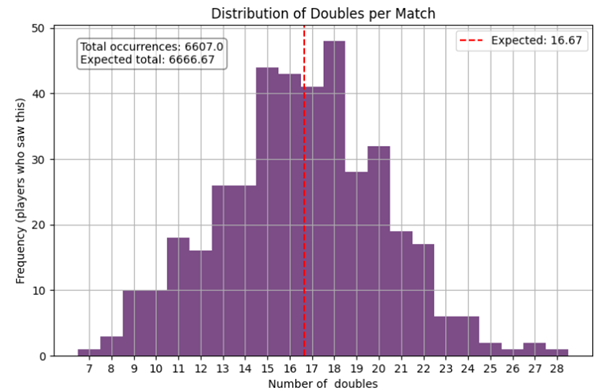
Quite a few lucky players saw more than 25 doubles in 100 rolls, more than 25%. Many saw less than 10. But the distribution around the expected mean is clear.

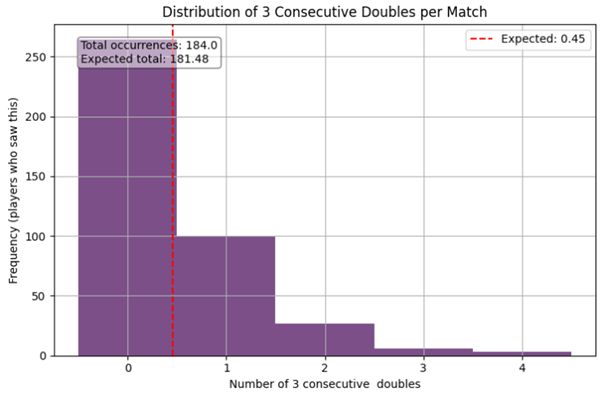

Some lucky players received four doubles in a row twice in a single match! Given we need to account for 30 occurrences in total across the 200 matches, this is not surprising.
Cryptographically sound
Well done for following to this point. This next section is quite technical, but I thought it worth including for those interested.
How does Hub generate the predetermined dice? Why can’t they be hacked by a tech-savvy player with lots of resources?
When a match is created, the site generates 5 “keys” corresponding to the letters A through E. These are stored in the database but kept secret until after the match. These are 256 bit keys generated by a cryptographic function that is also used to secure your credit card details online. The number of possible values for the key is roughly equal to the number of atoms in the visible universe.
As the match proceeds the system keeps track of the number of rolls made by each player. To determine the value of roll number N, it combines the key (secret) with N and then uses the SHA256 hash algorithm to generate another 256 bit number. SHA256 is designed to give deterministic but effectively random output.

Some people claim the site somehow manipulates the distribution of the dice, such as placing doubles close to the end of a game to make things more “exciting” (as if this were needed). Here is the code for the above algorithm:

The crypto.createHash function is provided by the NodeJS Javascript language framework. You can read about it here: https://nodejs.org/api/crypto.html#cryptocreatehashalgorithm-options.
Hopefully even non-technical readers can see the above code is short and doesn’t “know” anything about backgammon.
Thanks to Eran from OpenGammon for suggesting this approach.
Summary
Hopefully this blog post has gone some way towards convincing even the most hardened sceptic that the dice on Hub are fair and random. Here is a relevant quote from Richard Feynman to finish:
You know, the most amazing thing happened to me tonight. I was coming here, on the way to the lecture, and I came in through the parking lot. And you won’t believe what happened. I saw a car with the license plate ARW 357. Can you imagine? Of all the millions of license plates in the state, what was the chance that I would see that particular one tonight? Amazing!
Thanks for the article and your BG site. I will send any dice-skeptics here! But do some people even complain about Hub dice? That’s surely proof that (virtually) all of them have cognitive bias, as well as a run of bad luck/bad play!
This season in the Bristol 3rd league I have played live all but once and won 94% of my games. I’ve been accused of being lucky but after 16 matches and 15 wins people are starting to say it can’t all be luck.
Realistically I don’t believe I would have experienced the same level of success had I played online. Nothing to do with dice. I can pip count pretty well, but if I play online I don’t need to. My opponent also doesn’t need to and that does give an advantage to the weaker player, particularly when they are developing.
I think I would have lost more by playing online. That said! I’ll be playing a few online soon because I have to play a few really really tough players!
In reality online backgammon isn’t going to replicate the experience or the consistency of results that I would get by playing live. It interrupts a perfectly good chance to socialise and for these reasons I generally avoid this unless playing on the fairground which is fab!
Predetermined rolls kill any dice manipulation theory from the very start. For those who don’t believe it, just download the archive in your laptop before the match starts and double check that after the match ends. This feature also allows players to verify for sure if they would have won or lost any certain game where they passed a cube (thing which possible only on Backgammon Hub and is not possible on any other website).
Having the proof that there are always five fresh new predetermined series of rolls at the start of each match should be enough to make any sane person understand that Backgammon Hub can’t make up winners on purpose from the start of a match: just make a different play from what you did in a contact game somewhere along the match and obviously the rest of the game and match will certainly look entirely different, likely switching the winner. Or resign a game before your last roll/s when you are anyway sure to lose, and the next game will surely start with a different roll (easily verifiable thing) !
Interesting blog post….great analysis. I remember playing on a site called SafeHarborGames (think it’s still around today) where they openly stated on one of the room descriptions, the chances of rolling doubles had been manipulated from the expected number of every 1 in 6. As you say even with statistically random dice, people will still complain about “too many doubles”. So effectively they had to deliberately rig the dice, in order to convince people the dice weren’t rigged. Bonkers. Re your last comment…. “hopefully this blog post has gone some way towards convincing even the most hardened sceptic that the dice on Hub are fair and random”. I don’t think there’s any rational or sane argument that’s going to convince the tinfoil hat brigade that online dice aren’t rigged, you’re better off saving your time for something else!! 🙂
Gambling firms used to provide a platform for their clients to play backgammon against each other, with the winners paying a small percentage of their winnings to the gambling firms. I was told that some of these firms rigged the dice in favour of the weaker players because otherwise they would go away.
I do not believe that Hub, Heroes and Galaxy do anything dishonest.
There are several established tests of the quality of a pseudi-random numbers generator. I assume that the one you use is of the highest quality?
Brilliant analysis which will hopefully silence the doubters.