Backgammon seems more in vogue these days globally—from a proliferation of top-flight international events, to pub tournaments, to social games nights in members’ clubs. It is refreshing to see that Britain, although slightly late to the party in some ways, has finally arrived with gusto.
The UK is hosting the first ever World Backgammon Federation Championships in Earls Court in late August. And just a few short weeks ago, Anglo-American Jason Pack came in second at the World Championships of Backgammon—equalling the performance of another Anglo-American, Joe Dwek at the 1981 World Championships. (John Simon, a British national, also came second in 1992, but it appears he had elected to be considered a Hong Kong player, despite some misreporting on this point in various lists of Finals matches.)
Prior to Jason’s result earlier this month, Lawrence Powell had been the winningest British player at the Monaco World Championships in the Modern bot-era, coming 3rd in 2018 and 6th in 2017 and 2022. Also worthy of mention are John Broomfield and Eric McAlpine’s results also finishing third—in 2014 and 2015 respectively.

Jason therefore inadvertently followed in the great British tradition of usually being a bridesmaid and never a bride in football and backgammon competitions. He had placed second in the World Speedgammon Championships both in 2024 and 2025. Jason wrote about his speedgammon run for the UKBGF last year, but I’d like to use this opportunity to investigate what it takes psychologically and in terms of over the board prowess to make a deep run in a major international backgammon tournament.
My hope is to give some encouragement to competitive hobby players like myself, who tend not to travel abroad for major tournaments because they are time poor, value weekends with family, and implicitly assume they are unlikely to win many rounds against the world’s best. I went to Monaco for the first time this year and really enjoyed the atmosphere in the playing room.
I also came away with a few lessons, especially that it is critical simply to relax, play your own game and not make major changes because of either the opponent or the occasion. I had stumbled in my first match in the main tournament: passing a large no redouble/take while behind in the score. It was a modified four-roll, four-roll bearoff position; it would have been a redouble/take at an even score and was a big no redouble for my opponent as he was leading. What happened in my head is that, I didn’t want to risk 4 points against a seemingly worse opponent. I had massively overcompensated and dropped a pass. Out of an attempt to outplay my seemingly weaker opponent, I had been the one who had played weakly. I hadn’t played my game. It was my first major international tournament and going over my thought processes, I realize there is something to learn from a seasoned semi-professional like Jason. Jason faced a shockingly similar situation in his quarterfinal match against Phil Simborg, but handled it correctly, thinking for over a minute and realizing the 4 cube was a no-redouble and then taking. [I treat this position towards the end of the article.] Studying Jason’s matches, I can really see a consistent style throughout that I’ll be trying to emulate in the future.
Looking at Jason’s run, I conclude, the first thing that is critical to do to get deep in a major tournament: is to get a favourable draw. Last year, Jason thought he had a bye, then it was ‘taken away’ at the last second due to a late registration that was not entered into the paper draw in the playing room. By Jason’s account, this effected his mental state and both his dice and his skill abandoned him as he fell at the first hurdle against the incredibly strong Peter Jes Thompson. Although Jason played his worse match first, he would not stumble so profoundly in 2026.
This year, he started on Thursday morning not only with a free ticket into the second round, but also with what seemed a favourable draw. He faced the lesser-known, although relatively strong, American player Ian Terry. It was actually the most protracted and fascinating match of Jason’s tournament.
Terry is both a Southern gentleman and a fierce but relaxed competitor. By move 30 of game 14, Jason was leading 15-8 in a match to 17, with the cube accepted. Jason had an overall match-winning chance of more than 99.55%. The game itself had become a race, with Jason having six checkers off while Terry had none, leaving Terry with less than a 2.8% chance of winning the game. In fact, I can’t remember the last time I saw someone win an 8-roll vs 5-roll position with neither side missing.
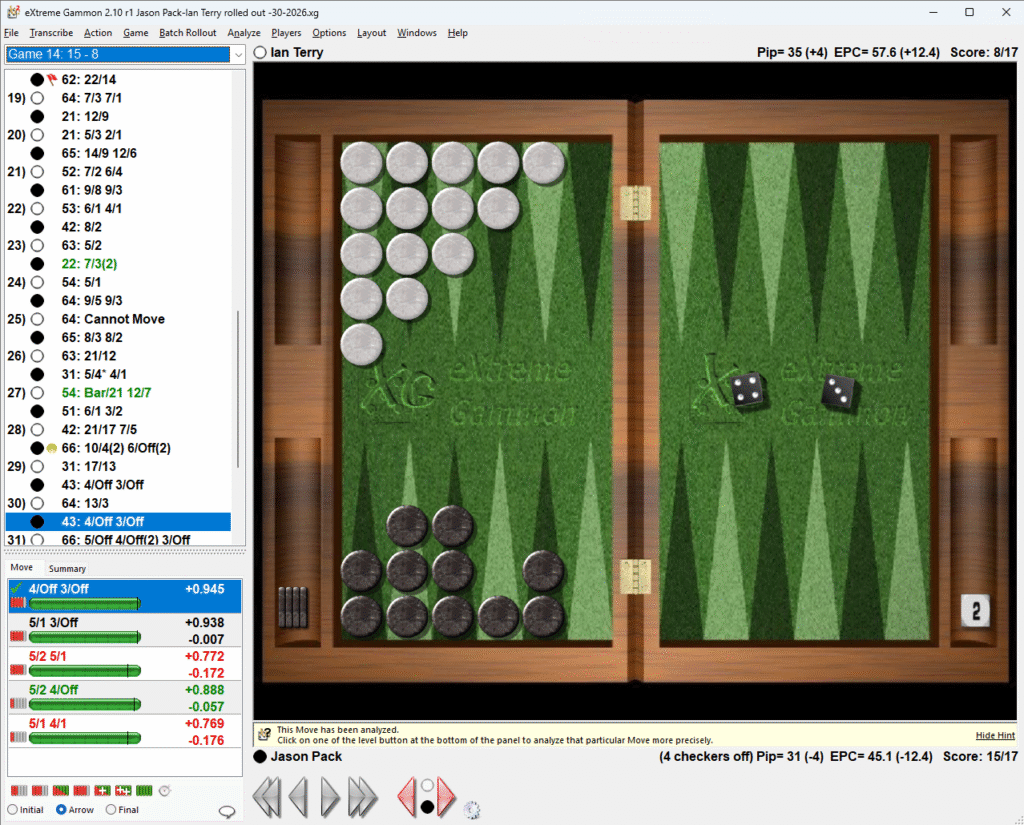
Immediately after Jason’s 43, Terry rolled double 6s, then double 4s and, two rolls later, double 1s. It was a slightly miraculous sequence, but this is the kind of thing you need if you are going to win a major tournament. Maybe it was Ian’s year not Jason’s?
Ian then played very cleverly over the next few games, slotting, priming, and finding perfectly timed attacking cubes. Jason was clearly rattled: he got low on time, then passed a take, and later took a gammonish drop. Speaking to Jason after the tournament, he told me that the most dispirited he felt in the entire tournament came when Ian had fought back to 3-away, 2-away and Jason was on the roof with two men, with more than an 85% chance of an undoubled gammoned. ‘I felt the entire tournament slipping away from me, I knew if I had played better I could have already won the match and if I would lose it would be my own fault.’
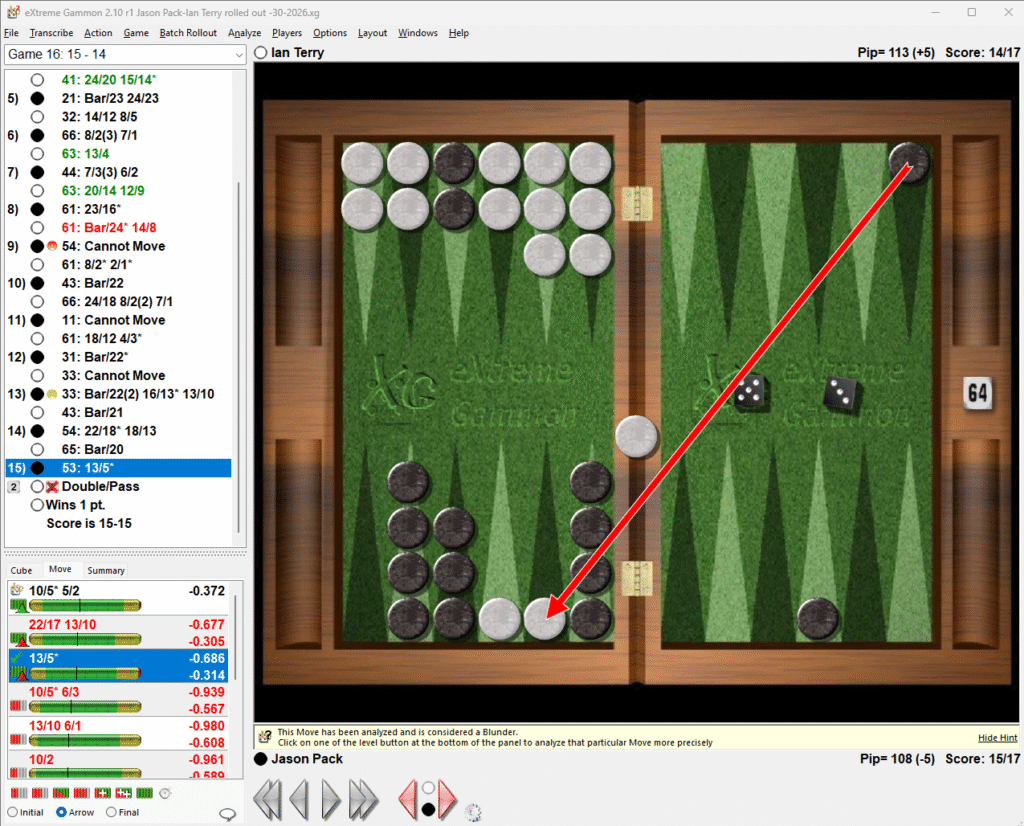
‘Even though I had rolled a joker double 3 two rolls earlier to save the previously likely gammon, I chose to play scared in game 16, move 15.’
More on this key move in Jason’s words:
My clock was running down. I had been on the verge of being closed out until I rolled the aforementioned double threes two moves ago. I initially thought the correct move in this situation was probably to come out with the 5 and face the music, but then I might have to take a double from the roof and could get gammoned to lose the match directly.
I was really experiencing my only panicked thoughts of the whole tournament. I was no longer thinking coherently about the position itself, but was scanning the room and reflecting about how I was now likely to lose from what had been a virtually gin position an hour earlier. So, after staring up into space and then at the clock, I chose to hit 13/5*, thinking it only left 12 shots from the roof and being on the bar might dissuade him from doubling.
I simply missed the safe pick-and-pass play. The degree of ugly stacking that it entails is not something one sees immediately, but as soon as it is pointed out, or you are switched on and see it, you can tell it is correct by a mile. But I was not playing my game at this moment and was not able to find the right play.
It would be Jason’s worst blunder of the whole tournament and the only mistake in over a thousand decisions he would describe as a pure oversight. He blundered the play and then deliberately blundered by passing the ensuing cube. He knew it was take with Terry shooting at him from the roof, but he was terribly antsy and anxious and didn’t want to lose the whole match that game.
Then he did what all top-flight players know to do after such a discouraging sequence — losing seven straight points and finding one’s self briefly an underdog after having been a 99+% favourite: he took a break. In the complicated DMP game that followed, he played at a 3.3 PR, while using the ploy of delaying the 2-away, 2-away cube in order to get Ian to take a cube that had become a slight pass at the score, but would have been a solid double/take for money due to the combination of black’s positional, racing, and attacking threats. Here, at this score, it is a sizeable pass for White simply due to White’s win rate being less than his chances trailing at 2-away, 1-away Crawford, which is 32%.
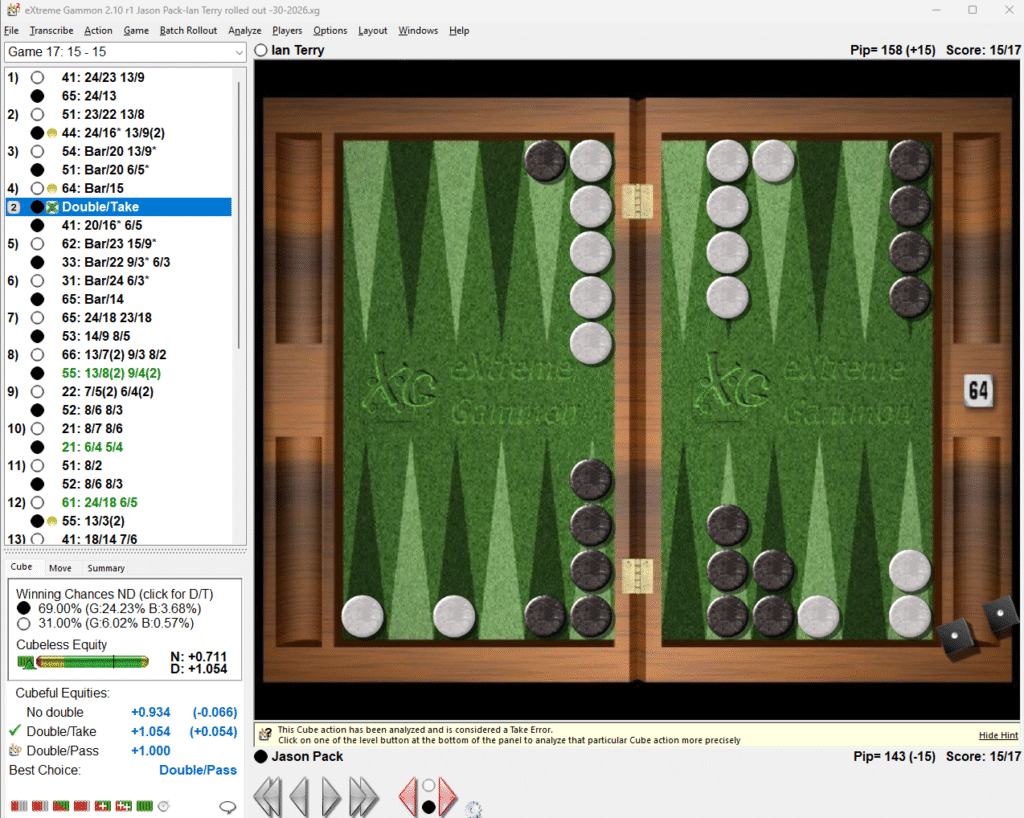
It was a courageous attacking manoeuvre for Jason , and very un-XG-like, to wait before cubing at 2-away, 2-away, in an attempt to trap Terry. He risked overshooting his market and losing equity, but the trap — and the mental preparation for it during the break — paid off handsomely, leading Jason to a very favourable holding game. It might have also lead to an incorrect pass if the sequence had played out differently.
Then, at move 12, Ian missed a tiny nuance that may have cost him the match.
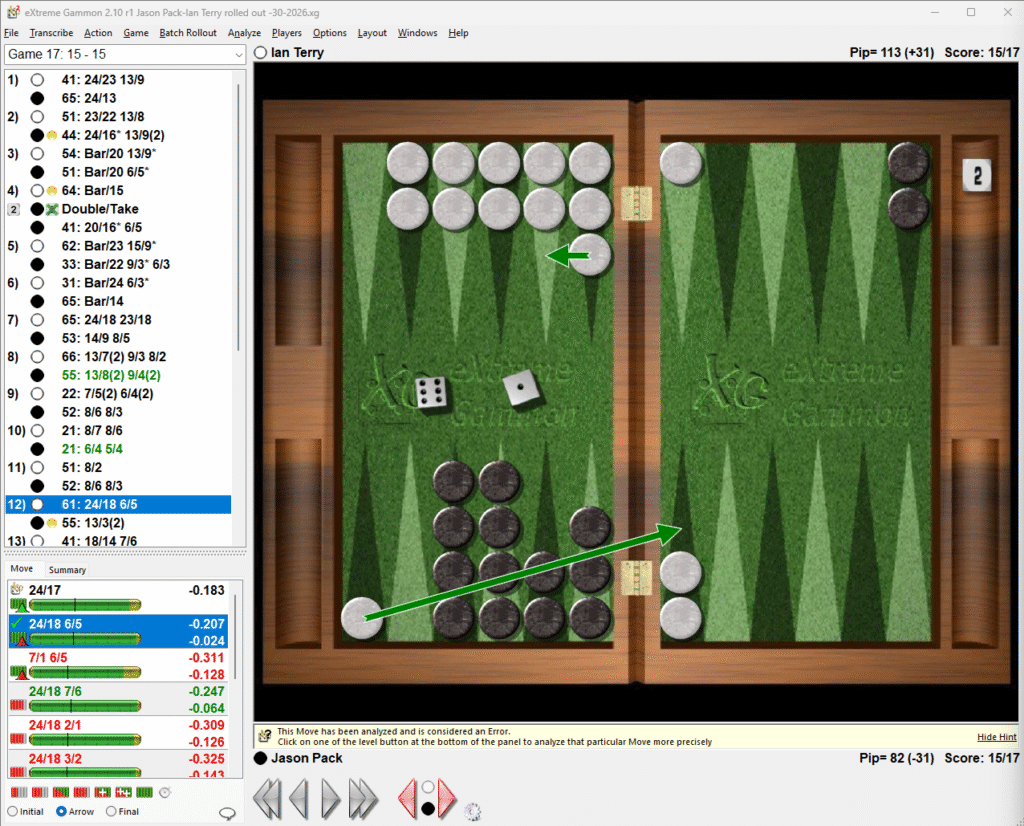
Almost nobody would find the bot’s play of 24/17 here. It is extremely counter-intuitive because, at a normal score, the play simply gets gammoned too often. At this particular score, however, gammons do not hurt. That makes it beneficial to get hit on double 5s, while also creating a double shot after every 6 other than 65 and 66. You need to realize that on normal 5s you are usually not getting a shot anyway so it isn’t a huge sacrifice to be on the roof.
It is an extremely difficult play to find, and Ian cannot be faulted for missing it. Jason punished the oversight throwing the biggest swing number – double 5s – and was through to Day Two of the tournament, where he would face the Danish GM1 and 2025 UBC Contender Tournament winner Thomas Myhr.
When I spoke to Jason afterwards about the experience, he said:
There was a sense, after halting Terry’s incredible comeback, that I was playing on borrowed time. I had been virtually gin in the match, with a 99.57% chance to win, and then found myself a distinct underdog at 3-away, 2-away as he played on for an undoubled gammon. I felt I had lost the match actually. Then finally at DMP, I was also a roll away from leaving a match losing shot. But somehow, I made it through. So, I told myself, I didn’t need to stress. I just needed to enjoy being in Monaco with many of my best friends and try to play my game. This is very much the attitude I embraced as I got deeper into the tournament. It wasn’t just a mantra it was becoming reality.
With the rest of the day off to swim, commentate and conduct the Auction at the Gala dinner, Jason tried to stay calm about being through to Day Two.


In the next match, and for the rest of the tournament, Jason got over his first-match wobbles and hit his stride. He tried to attack and put pressure on his opponents whenever possible. When things might go massively right, it is time to double. With this new philosophy in place, there were dramatic moments straight away against Thomas Myhr in the very first game: including the initial double, the first recube which Jason took to 4, and then his own early recube to 8—all pictured below.
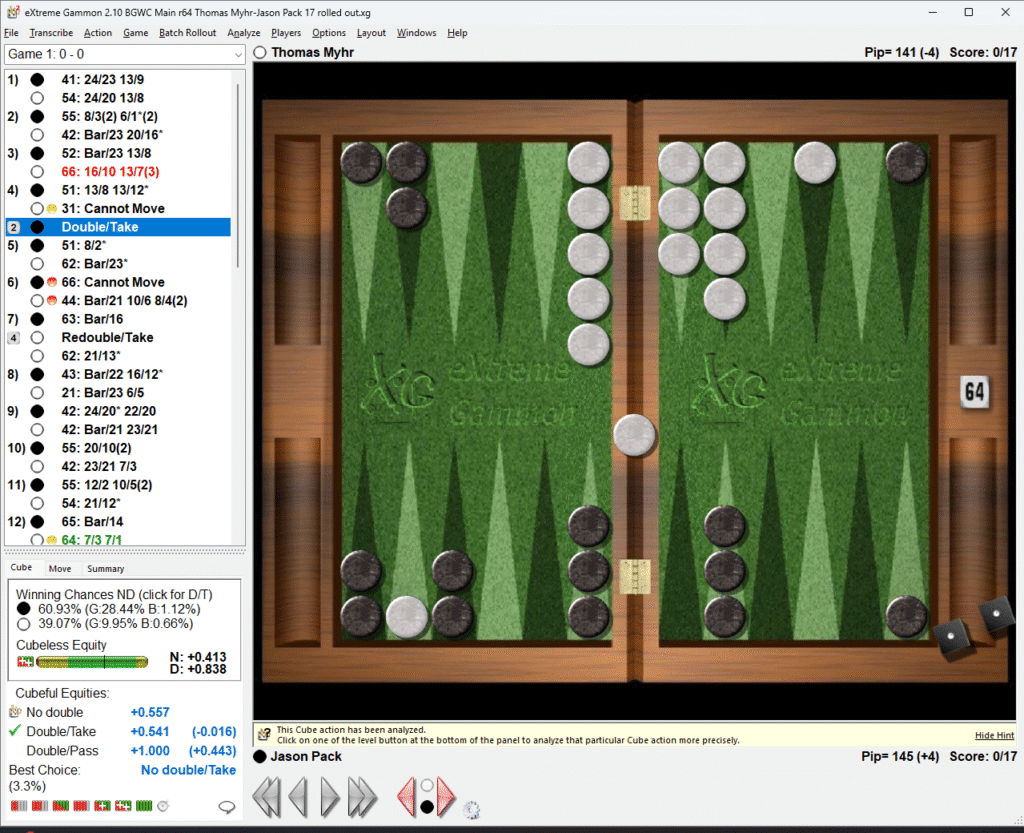
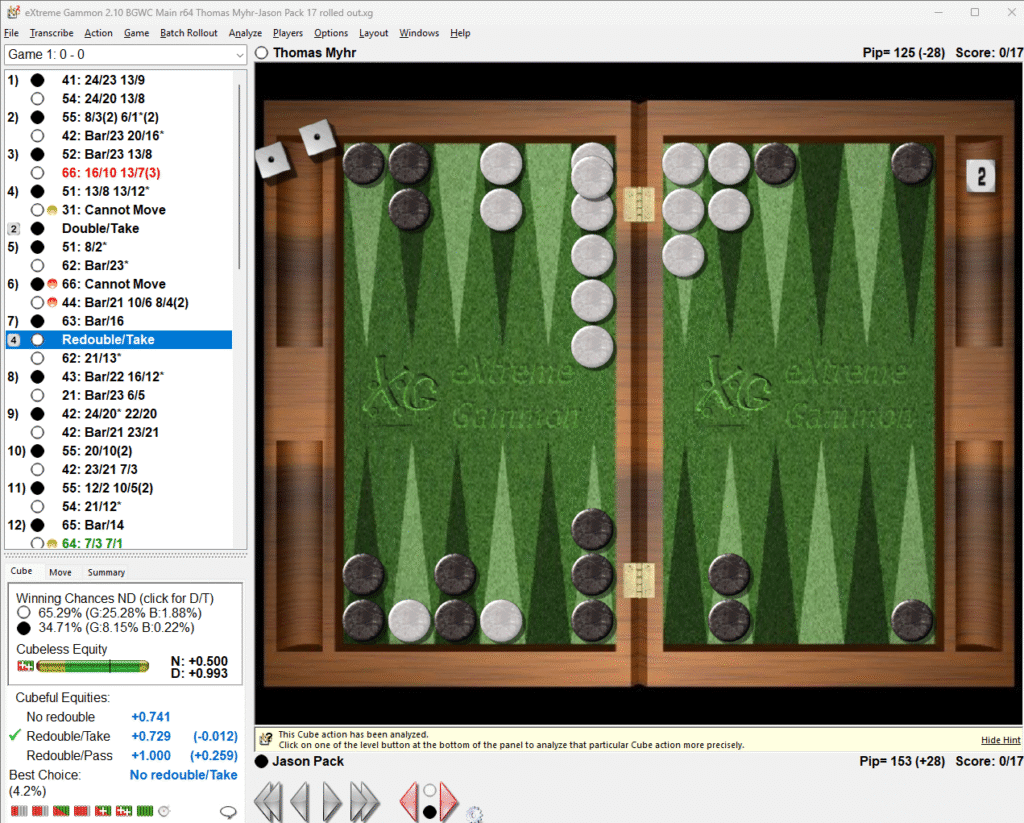
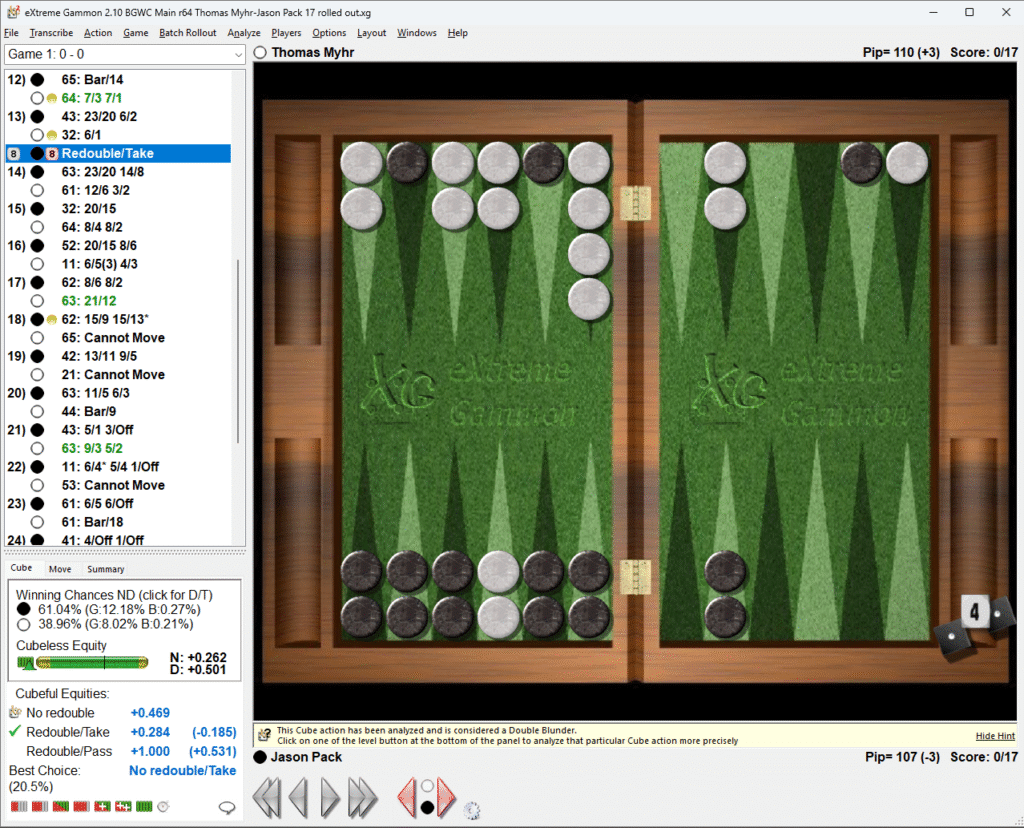
All of these decisions maximised Jason’s potential for good dice against a stronger opponent and kept the pressure on Thomas. Speaking to Jason, he told me he knew that the recube to 8 was probably early, as it surrendered a lot of recube vigorish to Thomas if he didn’t hit and later had trouble coming around. But hitting any ace, any 7, or double 5s could be so destructive. It would literally open the way to a 16-0 lead. So, looking at Jason’s play we can ascertain that he was trying to ride the wave and maximize his good dice. Such boldness appears uncommon among many of today’s second-rung of tournament players, who may lack the courage to take such calculated risks.
Although Jason only rolled a middling 63, played 23/20, 14/8, he coasted from that position and won the game. He continued to apply pressure, including with aggressive doubles such as this one when leading 9-2 to 17:
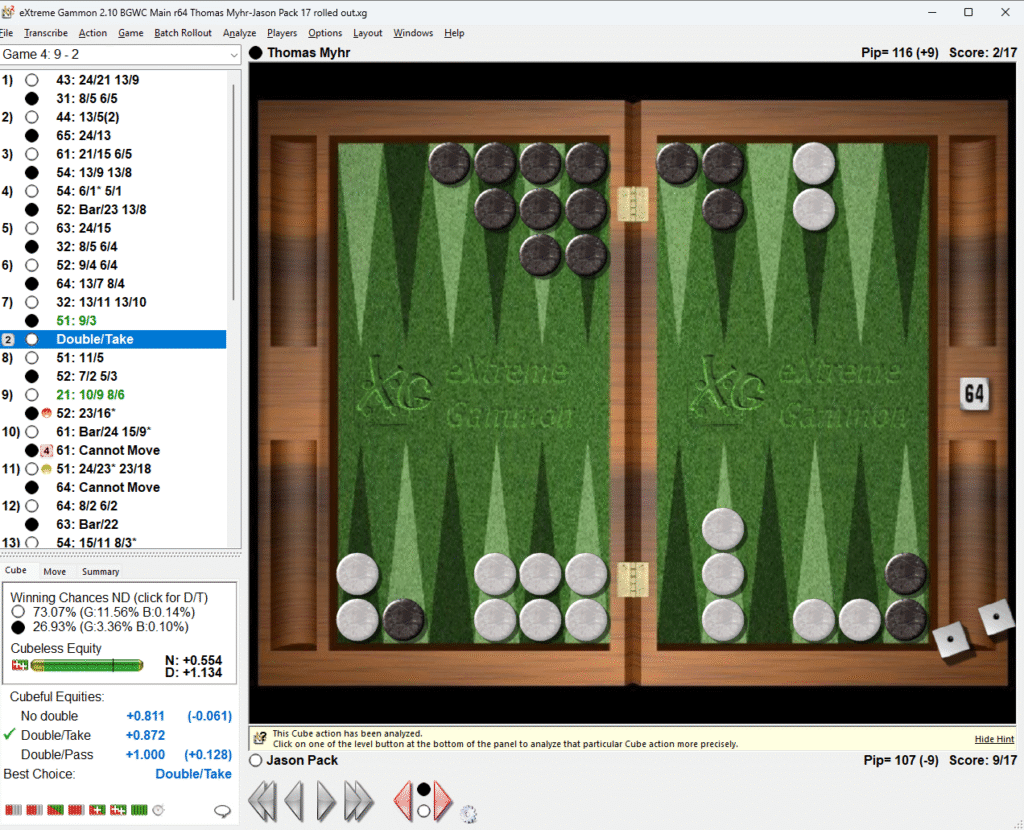
This is a genuinely courageous double that even many expert players would struggle to spot. The position is a double/take for money, but is rather miraculously still a strong double when leading by this score. The cube is correct because the position combines attacking, racing and priming threats. And despite this not being an endgame cube, there are not many chances for White to turn the tables and get a redouble take in after some freak fly shot.
Yet in the event, the worst case scenario almost materialized. Myhr did hit an 18-1 fly shot and then missed a recube from the roof in the ensuing hitting contest. Myhr subsequently fanned, Jason hit another man and went on to win a gammon. Jason then coasted to a 17-3 victory, having outplayed Thomas 3.97 to 6.57. Crushing dice and a crushing performance with some very complicated cube actions. It was Thomas’s worst BMAB recorded match in 2026.
In his next match on Friday afternoon, the fourth round of the tournament, he faced the experienced old-school Turkish player Erol Ozsoy.
Jason said he quickly got a feel for Erol’s tendencies and, for the only time in the tournament, made truly major adjustments to his normal style play as a result. Erol tended not to split his back checkers, and therefore got primed easily, busted frequently and passed often when the threat of such a prime was in play. Jason won nine of the 14 games in the match, with seven of those wins coming from Erol passing initial cubes — many of them incorrect passes. Sensing this Jason kept the pressure on and the cube flying to collect those points.
In the final game, at 6-away, 12-away, Jason decided to play aggressively for an unredoubled gammon or backgammon in the position below.
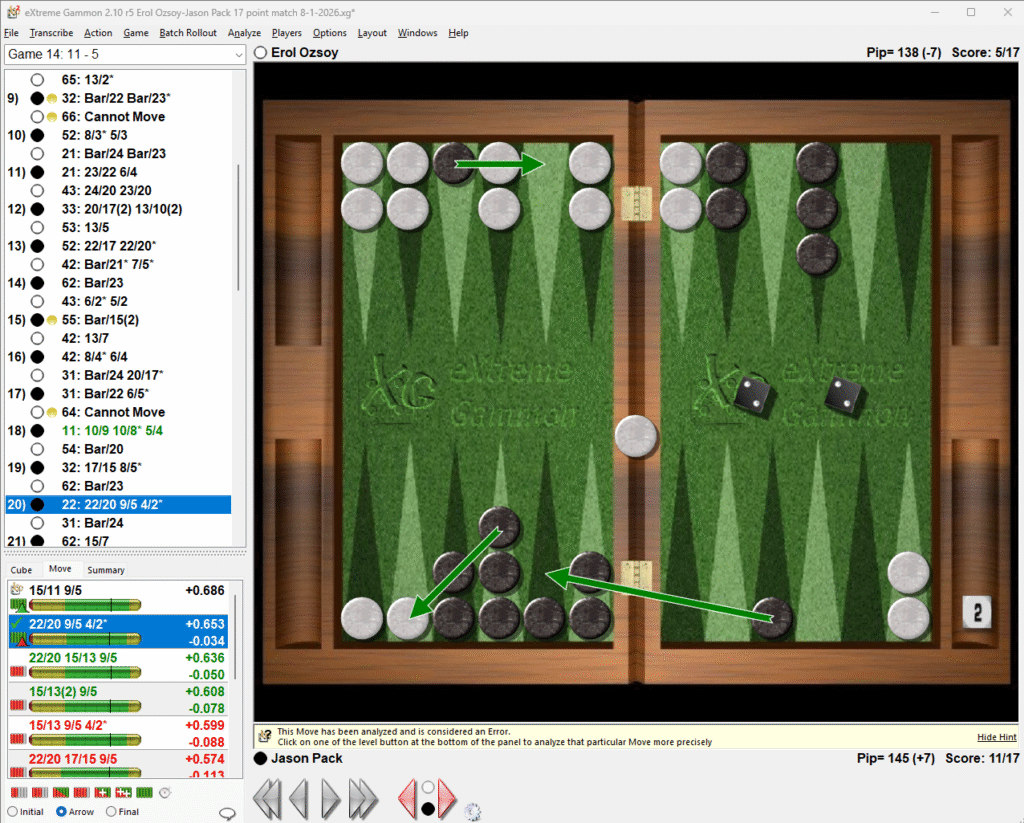
He maintained the attack for the next 23 moves and eventually scored a backgammon after Erol failed to run on two consecutive turns, moves 39 and 40.
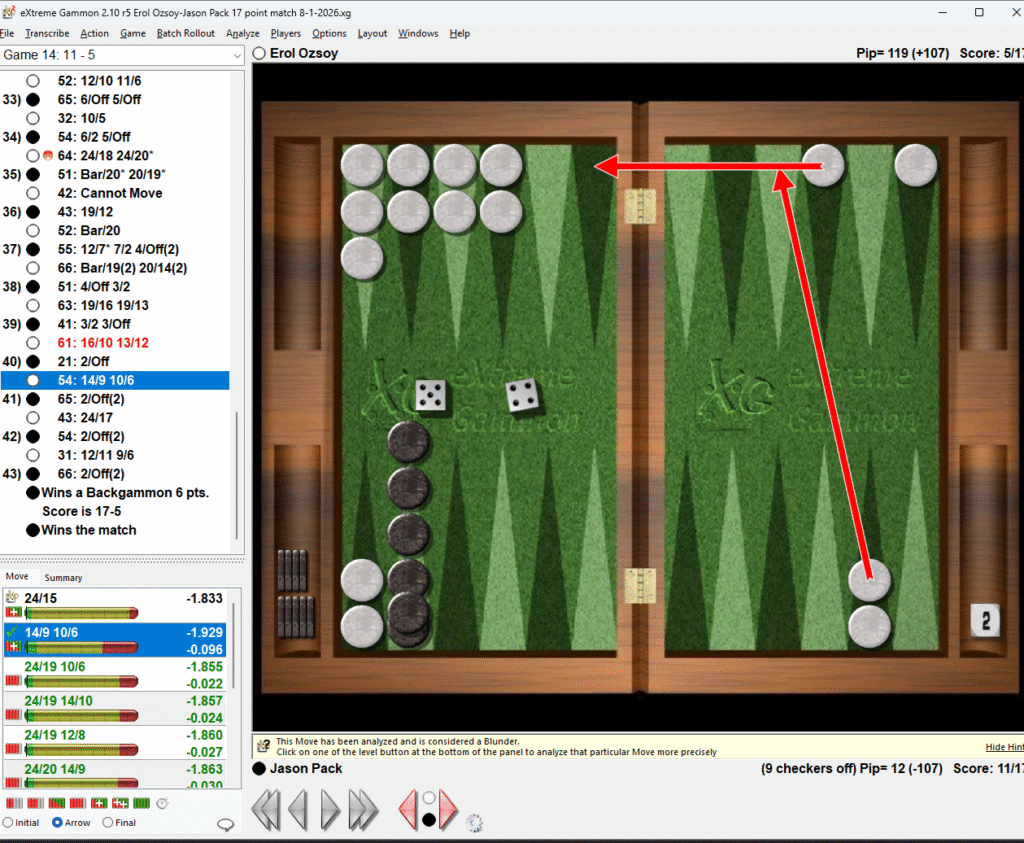
Here Erol may have thought that by staying back, the first ace could make Jason awkward and perhaps give him a last-roll double shot if Jason rolled an ill-timed ace. But this is misguided. Erol would have very little chance of winning even after a hit, while a backgammon would take Jason perfectly to a match winning 17 points. Therefore, getting out of the home board needed to be Erol’s clear priority.
Despite taking his opponent’s tendencies heavily into account, Jason had still successfully not deviated ‘too far’ from computer play. He had his opponent overmatched, outplaying him 4.9 to 12.3. According to XG his luck adjusted Match Winning Chances were: 64%. That is a difficult figure to achieve in round 4 of the Monaco tournament.
He was treated to a fantastic dinner by his generous New Jersey friends at their Villa in Cap d’Ail. Jason was dining while on the bubble: defeat in the round of 16 would mean no prize money and no glory.
He knew his fifth-round opponent very well. Phillip Marmorstein was a constant presence in the high-stakes chouettes of Victoria, Westminster, Hampstead, and East Finchley. Jason felt that he and his opponent, the winner of the World Championships in 1988, were fairly evenly matched and therefore proposed a sizeable equity swap hedge. Marmorstein declined, and Jason proceeded to roll him off the board.
Jason remained committed to attacking and positional play, cubing in positions that might not appear to be overwhelming — just as he had against Myhr — but where missing the market could prove costly. Above all, he vowed to use his good dice to keep the pressure on his opponent.
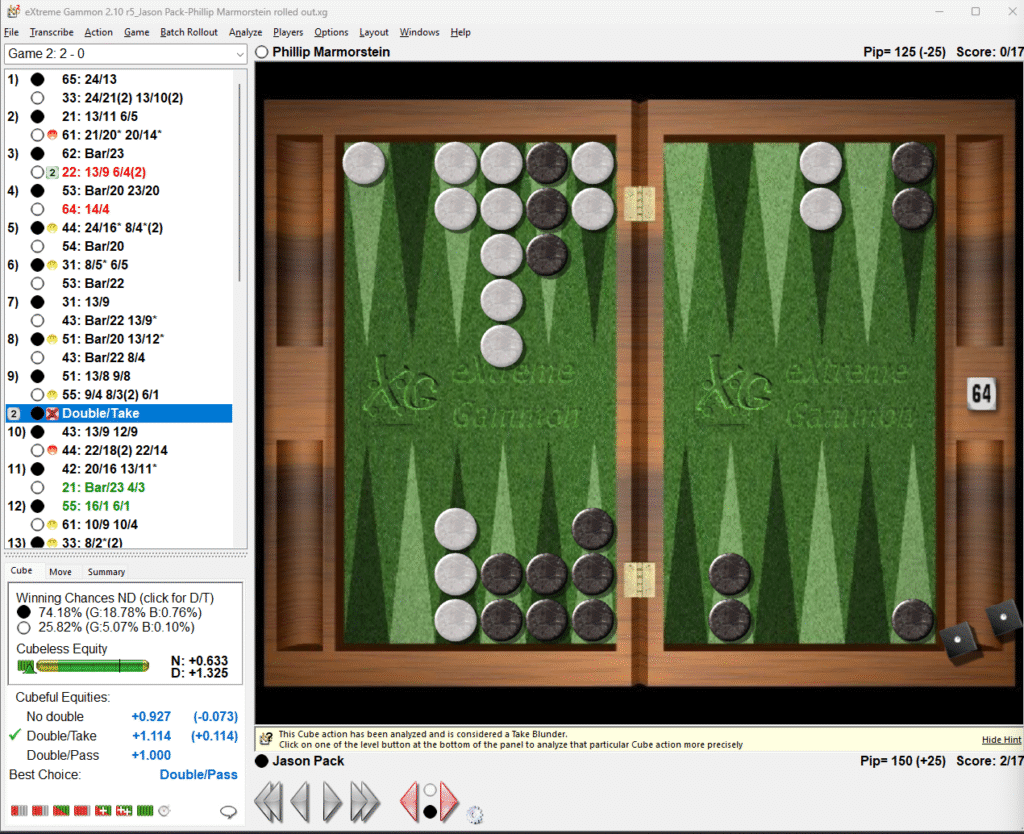
After Phillip’s incorrect take, in the above position, Jason scored an unlikely gammon to take a 6-0 lead. He never took his foot off the gas, eventually winning 17-5 and continuing to cube aggressively and go for gammons even when ahead. This is another thing that seems to differentiate the top players from the skilled hobby players, not getting too passive when ahead. Any fairly competent player can play aggressively when behind, but balancing caution and attacking when ahead in a match and not giving away points out of fear is truly world class play.
After dispatching Marmorstein, there was now a new bounce in Jason’s step. He was safely in the money rounds and felt he had a relatively good draw: the other side of the bracket in the round of 16 contained Jörgen Granstedt, Petko and Abe Mosseri. He began to think that perhaps this really could be his year. Despite the incorrect take pictured above, the London-based Marmorstein had played the match brilliantly, outplaying Jason by 3.6 to 5.1.
Having won quickly, Jason had a long time to cool his heels while he watched the veteran backgammon teacher Phil Simborg mount a miraculous comeback against the old-school Israeli player Aviv Azoulay.
Against Phil, Jason did not even contemplate a small hedge. He was really beginning to feel that this could be his year and didn’t want to give away equity when he felt himself a significant favourite. He also thought it would take the pressure off. His strategy was about keeping the pressure on. He deliberately sought to complicate the games and, as he pulled away in the match and sensed Phil’s desperation, Jason succeeded in getting Phil to take some passes by delaying the cube.
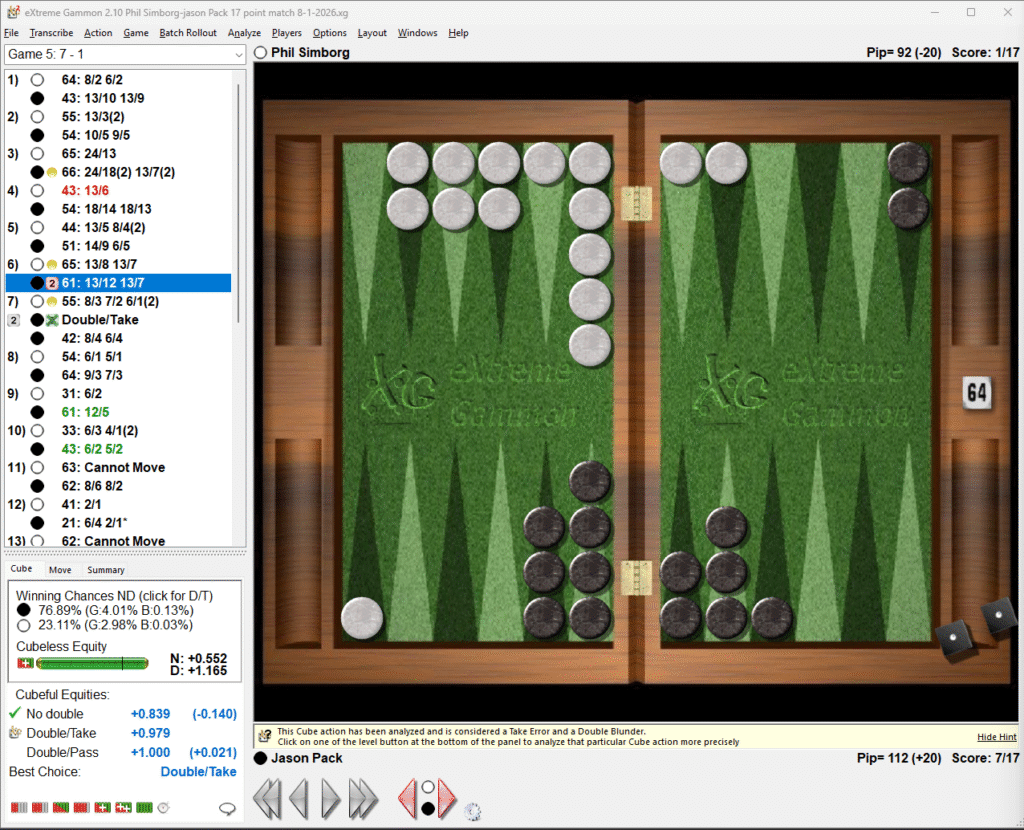
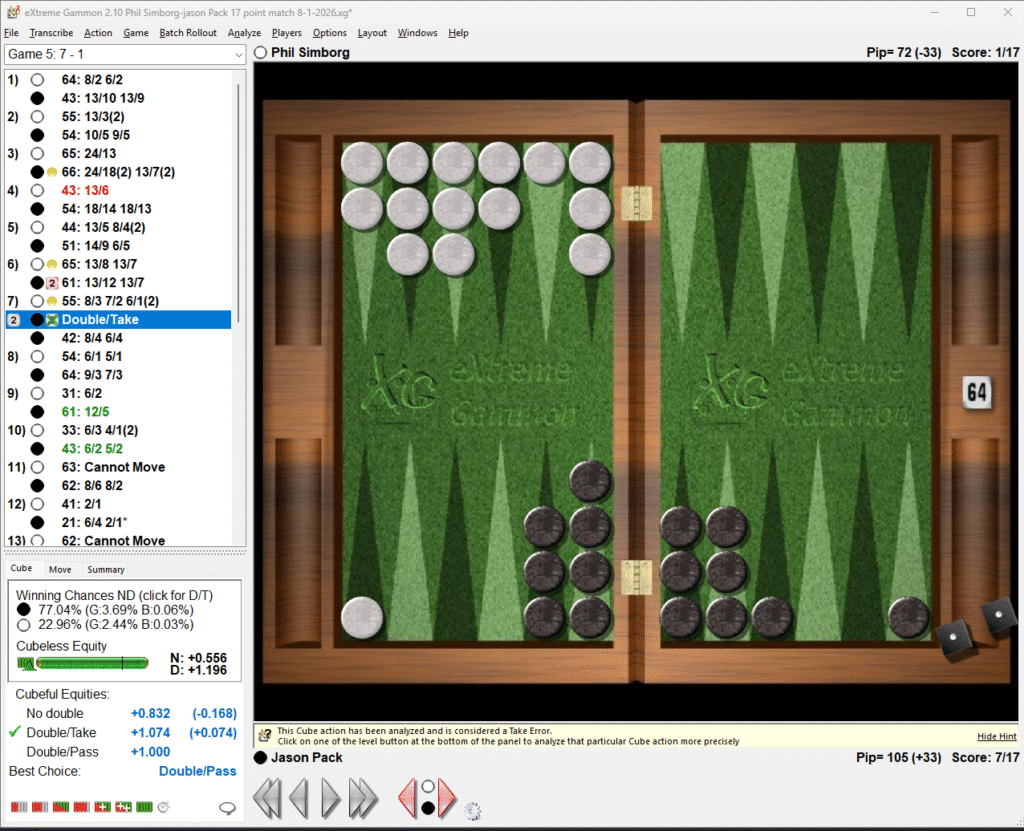
According to Jason:
I had the sense that it was a cube the turn before, but for Phil despite his disconnected position I reason that with him being ahead in the race and down 7-1 in the match, he might take later even if I made the five-prime or he busted. So, in the event, he threw his worst busting number, double 5s, and still took the next roll.
Somehow, Simborg turned the game around after getting closed out, entering with double 6s after Jason had borne in, and then winning the race.
The next game was a complicated 45 backgame in which Jason again delayed his cube, technically missing his market by a roll, but still getting a take later.
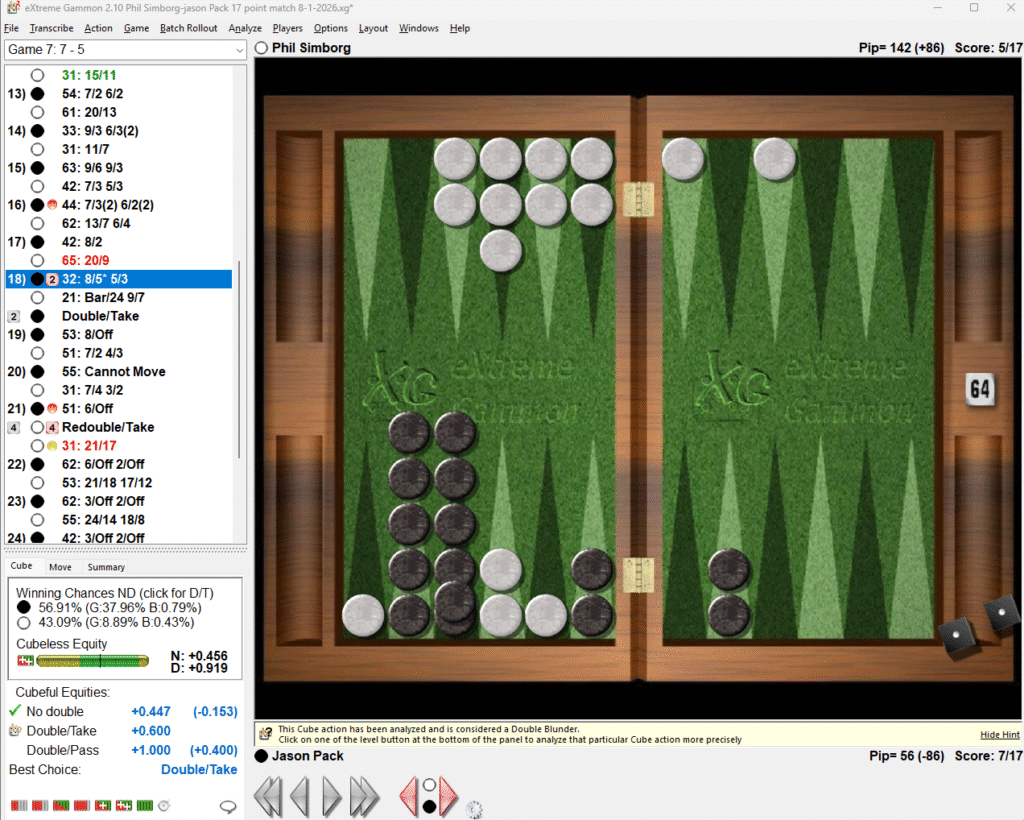
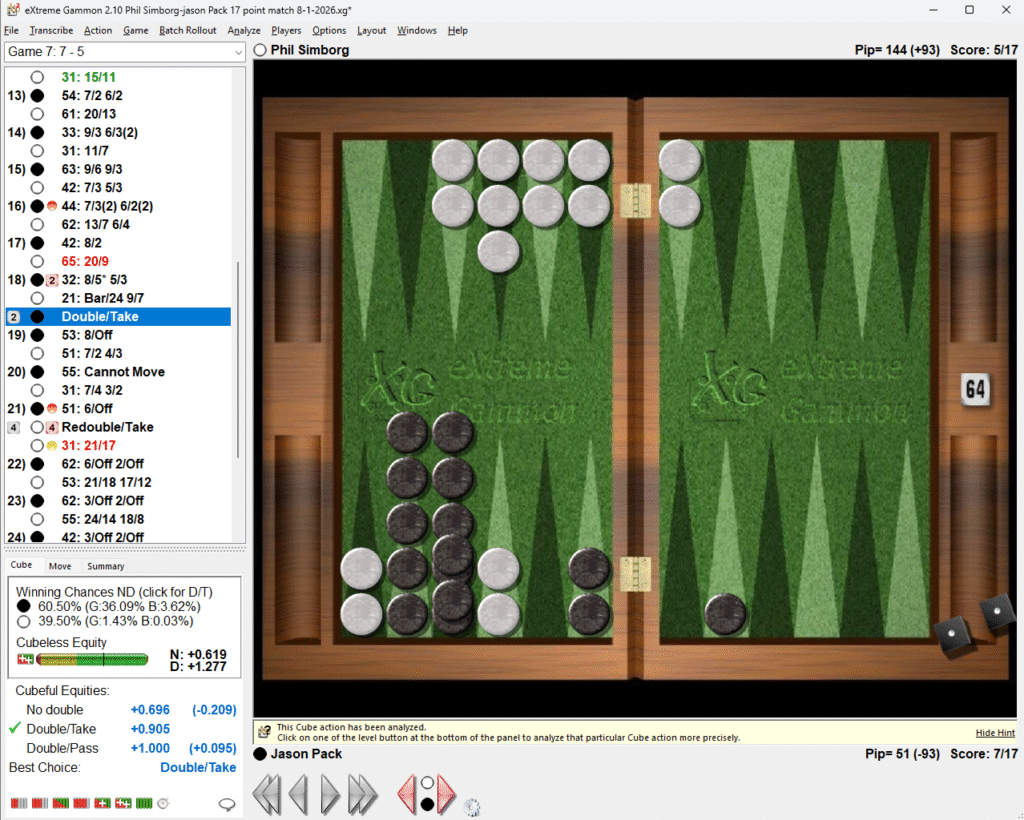
Phil had again dropped into a complex backgame, then the game turned against Jason and he left a double shot. Phil thought for a while and then recubed.
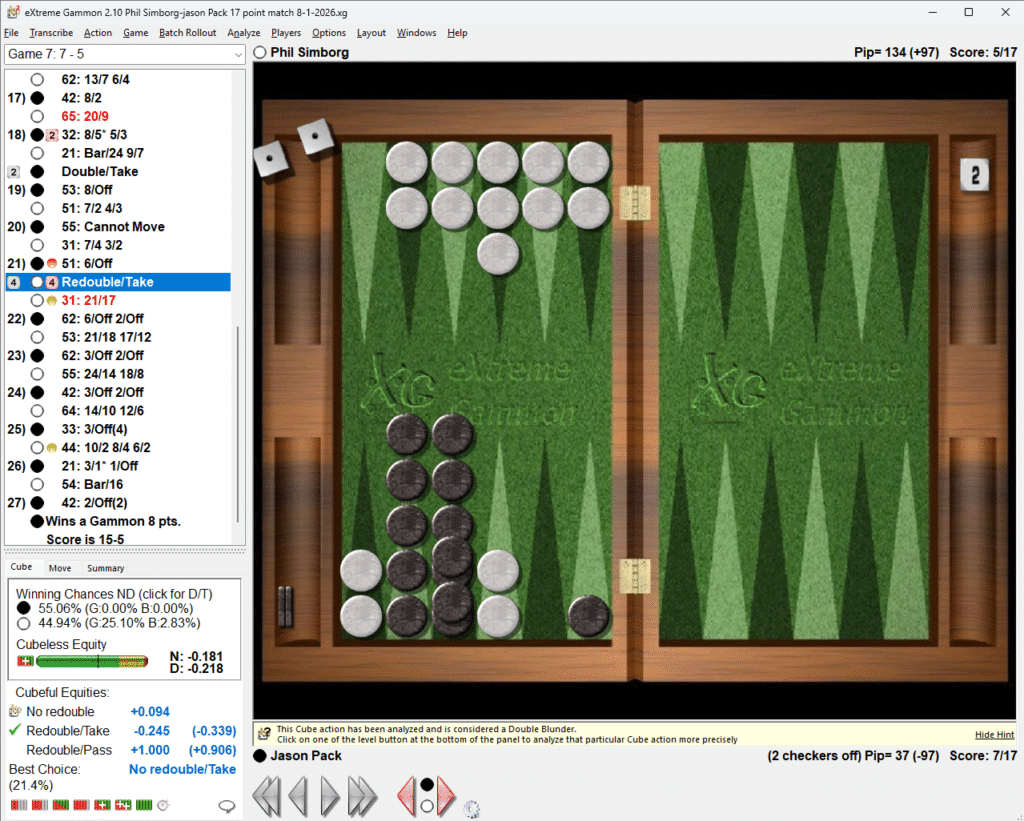
Speaking to Jason after the match, he told me his initial thought was that this could not be a redouble, because he could still win an eight-point unredoubled gammon if Phil missed and could not be gammoned if hit. But he was also slightly tempted to pass because he felt he was an underdog in the position and feared that Phil could simply get lucky, hit and then go on to win the match.
According to Jason:
I realised it must be a beaver for money and that I would become too good on all misses, and hence it would be insanity to pass. Yet, I must confess that there is a temptation to pass that one must overcome. I simply had to put aside my fear of getting hit. I knew it is a huge take, so I took, he missed and I got an eight-point gammon to all but stitch up the match. Phil then made some funky plays in the last game out of a desire to attack even when he had four men back, and it was not too hard to cruise to another 17-5 victory. That said, Phil had mixed it up and had given himself a chance to win by increasing the volitility. And he is to be credited for playing ‘his style’.
Jason had outplayed Phil 3.8 to 8.2, even despite some deliberate missed doubles. He was through to the semi-finals. He had done what I failed to do in my 4-roll, 4-roll position; he had not overcompensated or succumbed to those voices of fear in one’s head that make you want to pass when you are a favourite to lose four points but when you know you are supposed to take.
Traditionally, the semi-finals and final of Monaco are not played on the same day, meaning that the final pairing is set before both players go to sleep on Saturday night.
But not this year. Jason would have Saturday evening off to relax, treating his friends to dinner at a favourite restaurant and trying to distract himself from the battles that lay ahead on Championship Sunday.

As Jason tells the story of his next morning,
I awoke surprisingly relaxed, slightly hung over, and a little dazed from a Valium taken after dinner. Although I knew it would be a day I would never forget, I felt ‘relatively’ calm going through my morning routines: studying the previous day’s matches at breakfast, a quick swim, stretches, and then a long bath. Comme d’habitude. I knew I was going to be playing an unflappable and slightly technically superior player in the semi-finals in Naoki Iketani. Therefore, unlike the ‘compensation’ I did against Phil or Erol, I knew I had to simply play my game. Also unlike against Thomas Myhr back in the 3rd round where I felt quite overmatched heading into the match, I didn’t feel that in this instance I needed to super press. I had settled into a rhythm and knew I just need to play as well as I could. Fortunately, as the dice fell, I ended up with decisions that I mostly knew I could make correctly.
Rather than presenting any positions from that match, I direct you to the truly excellent commentary by Mochy and the UK’s own Justin Nowell and Miranda Moulton on YouTube. Jason played a brilliant 2.5 against Iketani’s 4.2. There were simply too many interesting positions and dynamics to cover sufficiently here.
Speaking to Jason afterwards, he described to me being in a flow state during the match and just letting the moves play themselves without really exerting much control. Sounds to me like all of his years of practice and high stakes training just kicked in and paid off!
As for the final, rather than feeling the nerves he expected, Jason described having an ‘out of body-style experience’ in the streaming room where he was not consciously playing the match, rather he was on a kind of autopilot. Many elite athletes describe ‘the flow state’ in similar terms. He continued to play his game despite facing the many challenging decisions caused by his horrific dice. You can watch Marc Olsen, Justin and Miranda’s excellent commentary here. Speaking to me about what he recalls from the match, Jason hoped at two instances in the first game that he could cube Petko ‘later’ to get him to take a small pass if things went well. This was delusional and idealistic on Jason’s part. Then seeing later in the match that Petko was not taking late but in fact dropping early, Jason was able to steal a point in game 11 on the third move with an early very takeable blitz cube.
However, despite some tiny game strategy like that at the margins, the way the dice fell in the final, Jason had no chance. He delayed two tiny cubes. All of his offered doubles were spot on. He made two correct passes and 4 takes in the match, three of them correct. Jason’s first take was a .12 blunder. The last take was quite courageous, but significantly technically correct. He was anchored in all the takes and had relatively low gammon rates against him. Nonetheless, he got gammoned in his first three takes and backgammoned to lose the match in the last one. Despite that ill-luck at the end, someone has to win and someone has to come 2nd. It was a worthy combat and one of the better played finals in recent years. Jason had played fearlessly, especially in his last decision of the 2026 World Championships, where he correctly decided to not run off to save the BG.
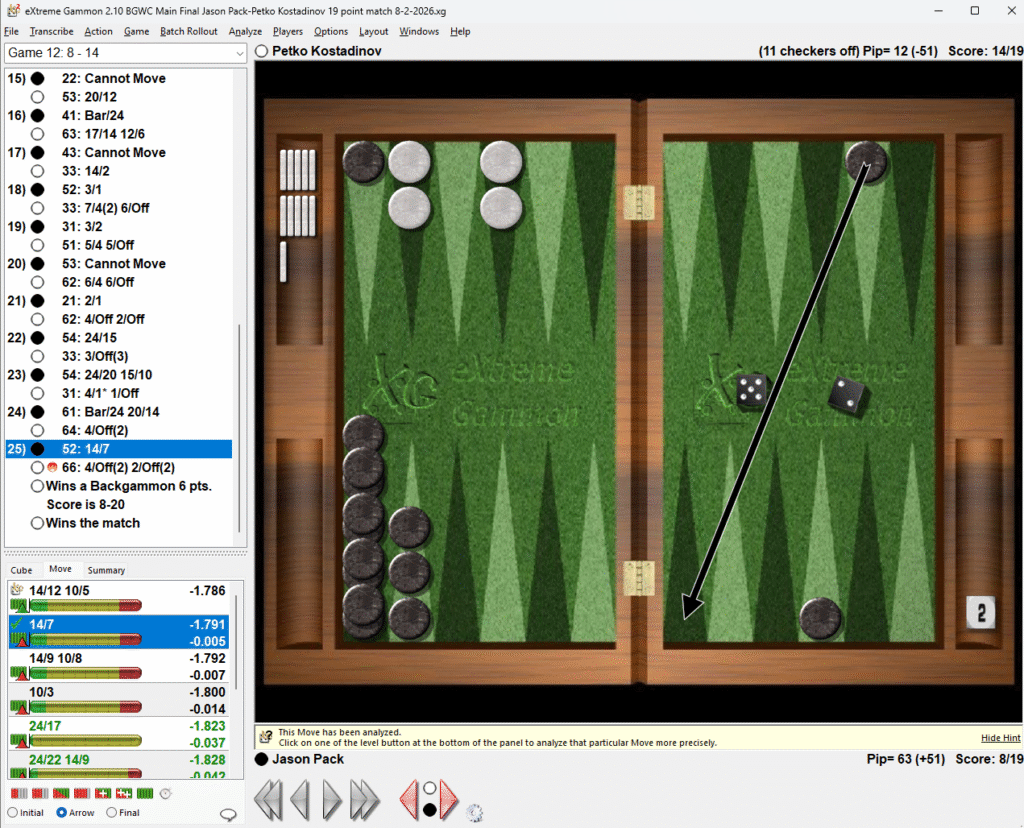
Petko prominently rolled boxes to win the World Championships with gusto. He had been the consummate gentleman and had played impeccably. He too had kept the pressure on Jason with many accurate cubes even when ahead in the match. Petko had shown his mastery of match backgammon.
It was nonetheless a fantastic run for Jason and studying it can teach other British players some key lessons about top flight tournament backgammon: play your game; adjust to the opponents, but not too much; don’t change your game day routines; try to have fun and hang out with friends even when still alive in the tournament; don’t let the pressure get to you, don’t be passive; and fight to cube aggressively when you can—even when ahead.
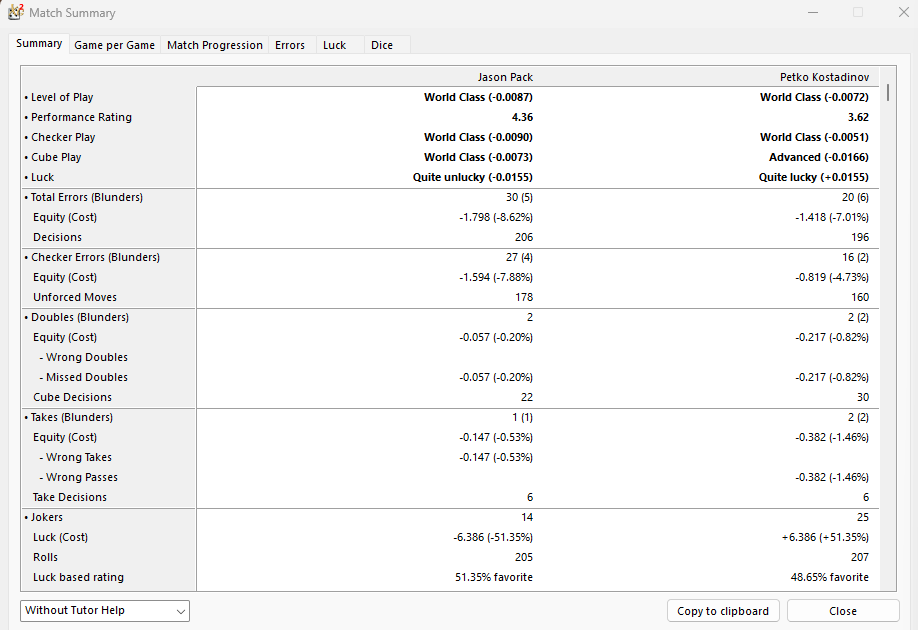
In the final, Petko had slightly out-PRed Jason 3.6 to 4.3, but according to XG Jason’s play had made him a small favourite in luck-adjusted match winning chances. Petko’s checker play had been truly stellar, but Jason’s cube play had been exceptional making only one blunder to Petko’s four.
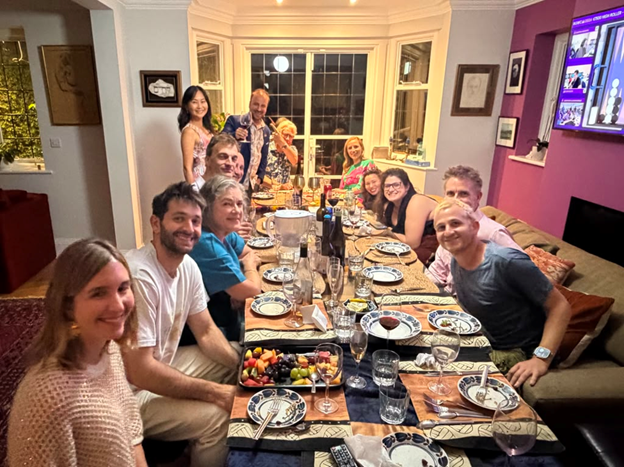
Losing is never fun, but Jason tried to put a happy face on it. His 2nd place speech at the prize ceremony was a moment of real class. His run to the final was a crowning moment for British backgammon.
I was about to say that this is the best article I have ever read from Will, the most prolific of event write up posters, but then I discovered it was actually Andrew who was the author 🙂
Great read and a top summation of JPs journey, with due respect to him for his input.
Opponent match adjustments are an interesting subject. What works today might not work tomorrow.
My advice as a backgammon coach is not to adjust unless you are a very experienced player and a good reader of other ppl’s psyche.
You are more likely to make an error than achieve a short term advantage.
The same applies in poker. There are many styles of players. Playing to your strengths and character is much easier and consistent than shape shifting every hand, game or match.
Just don’t become exploitable or observant players like JP will pounce.